 PickPundit
🔧 How to Choose the Best Cordless Drills: Complete Buying Guide

Complete cordless drills buying guide. Learn what features matter, compare top products, and find the best cordless drills for your budget.
View Top Picks →Table of Contents
Cordless Drills: Voltage, Torque, and What DIYers Actually Need
Cordless drill marketing emphasizes voltage and power claims, but matching drill capability to actual use cases matters more than maximum specifications. Understanding what different voltage classes actually deliver helps avoid overpaying for power you'll never use—or underpaying for inadequate tools.
Voltage Classes Explained
Voltage roughly indicates power potential:
12V: Lightweight, compact, sufficient for most household tasks. Driving screws, drilling in wood and soft materials.
18V/20V: The workhorse category. Handles all household tasks plus moderate construction. 18V and 20V are marketing differences—functionally equivalent.
24V+: Heavy-duty construction use. Overkill for typical DIY, adds weight and cost.
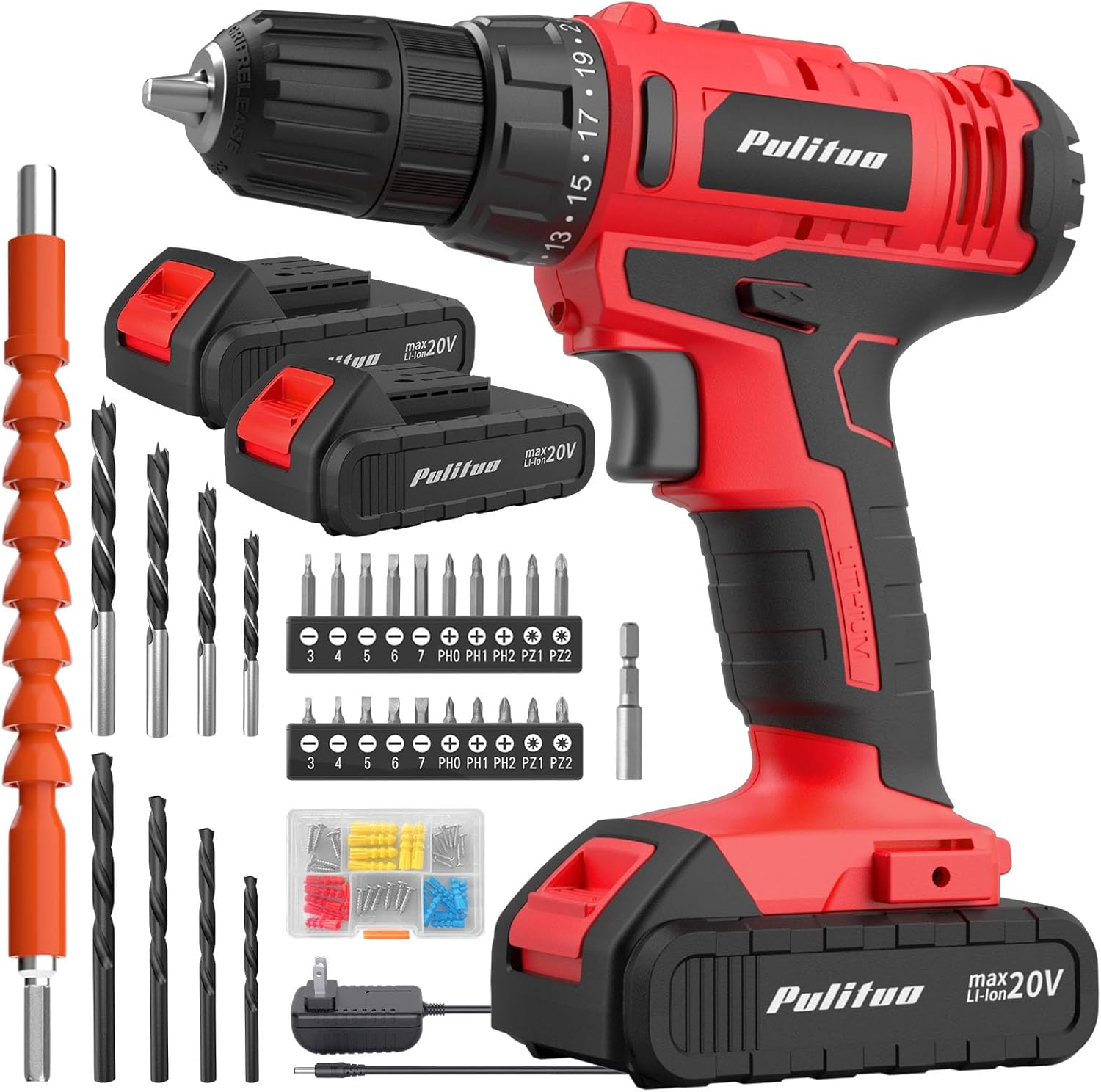
The PULITUO 20V at around $35 represents the versatile mid-range—adequate power for home improvement without professional pricing.
Chuck Size and Bit Compatibility
The chuck holds drill bits:
3/8" chuck: Standard for most drills. Handles bits up to 3/8" shaft diameter. Sufficient for household use.
1/2" chuck: Accepts larger bits, indicates more powerful tool. Needed for larger holes and heavy-duty drilling.
Keyless chuck: Tool-free bit changes—standard on modern cordless drills. Keyed chucks are rare now.
Brushless vs Brushed Motors
Motor technology affects performance and lifespan:
Brushed motors:
- Cheaper
- Less efficient (more heat, faster battery drain)
- Parts wear requiring eventual replacement
- Adequate for occasional use
Brushless motors:
- More expensive
- More efficient (longer runtime, less heat)
- Longer motor lifespan
- Better for frequent use
Budget drills like the PULITUO typically use brushed motors—fine for occasional DIY, limiting for heavy users.
Speed and Torque Settings
Drills offer multiple settings:
Variable speed trigger: Pressing harder = faster rotation. Essential for control.
Two-speed gearbox: High speed (drilling), low speed/high torque (driving screws). Many drills include this.
Torque clutch: Numbered settings limit torque, preventing screw overdrive and cam-out. Higher numbers = more torque before clutch slips.
Hammer function: Some drills add hammer action for masonry. Not all cordless drills include this—verify if needed.
Battery Considerations
Battery system defines long-term value:
Included batteries: Budget drills often include lower capacity batteries. Upgrade potential varies.
Battery compatibility: Major brands (DeWalt, Milwaukee, Makita) share batteries across tools. Budget brands may not.
Spare batteries: The PULITUO includes two batteries—essential for extended work without waiting for recharge.
Charging time: 30-minute fast charging vs 3-hour standard affects workflow significantly.
Electric Screwdrivers vs Drills
Different tools for different jobs:
Electric screwdrivers:
- Lower power, smaller size
- Driving screws only
- More compact and lighter
- The cordless screwdriver in listings suits light assembly
Drill/drivers:
- Drilling and driving capability
- Larger, heavier
- More versatile
Impact drivers: Even more torque for driving, not ideal for drilling. Separate tool category.
Weight and Ergonomics
Tool weight affects usability:
Light drills (under 3 lbs): Easier overhead work, less fatigue. Usually lower power.
Heavy drills (4+ lbs): More powerful but tiring for extended use.
Balance: Well-balanced drills feel lighter than actual weight.
Grip design: Comfortable grip matters for extended use. Rubber overmolds reduce fatigue.
What DIYers Actually Use
Realistic assessment of household drilling needs:
Common tasks: Hanging pictures, assembling furniture, installing hardware, light repairs.
Occasional projects: Deck screws, shelf installation, cabinet mounting.
Rare heavy-duty: Most homeowners rarely drill concrete or drive large lag screws.
A 12V-20V drill/driver handles 95% of household needs. Higher voltage justifies cost only for frequent heavy use.
Kit Contents
What comes with budget drills:
Bits included: Many kits include basic drill and driver bit sets. Quality varies—often worth replacing with better bits.
Carrying case: Keeps drill and accessories organized. Soft bags or hard cases both work.
Accessories: Some kits include flashlights, tape measures. Nice extras, not purchase drivers.
Brand Considerations
Brand affects support and ecosystem:
Major brands (DeWalt, Milwaukee, Makita, Bosch): Quality consistency, service network, battery ecosystem expansion.
Budget brands (PULITUO, DCA): Lower initial cost, variable quality, limited ecosystem.
Recommendation: Budget brands work for occasional DIY. Frequent users benefit from major brand ecosystems.
Practical Recommendations
For occasional DIY: 12V-20V budget drill with included bits. PULITUO-type options deliver adequate performance affordably.
For frequent home improvement: 20V brushless from major brand. Battery ecosystem enables future tool additions.
For heavy construction: 20V+ professional grade. The difference in durability and power justifies professional pricing.
For furniture assembly: Electric screwdriver may suffice. Less versatile but lighter and simpler.
The key insight: match drill capability to actual use. Most homeowners never need professional-grade tools. A reliable 20V drill/driver handles virtually all household tasks—save money for quality bits, which matter more than drill brand for clean holes.
Frequently Asked Questions
What should I look for when buying cordless drills?
Key factors include build quality, user reviews, and value for money. Top-rated options like the PULITUO PULITUO 20V Cordless Drill/Driver (4.5★ from 1,646 reviews) demonstrate what quality looks like in this category.
How much do cordless drills typically cost?
Prices range from $21 to $239, with most quality options around $82. Budget options under $31 work for occasional use, while premium models over $123 offer better durability and features.
Which cordless drills are most popular right now?
The PULITUO 20V Cordless Drill/Driver is currently top-rated with 4.5★ from 1,646 verified reviews. Check our full comparison at /best/cordless-drills for all top picks.
⚖️ Quick Comparison
| Product | Price | Rating | Key Feature |
|---|---|---|---|
| $35.99 | Powerful 20 V Motor and 2 x 1.5 Ah Battery Equipped with a robust 20 V motor and... | ||
| $20.99 | Durable and Easy to Charge, Long-Lasting Power Equipped with a large-capacity 13... | ||
| $29.99 | 354 In-Lbs Torque - The 20V power drill delivers 354 in-lbs of torque with 18+1 ... |