 PickPundit
📦 Kuinka valita parhaat lattiakaiuttimet: Täydellinen ostoopas

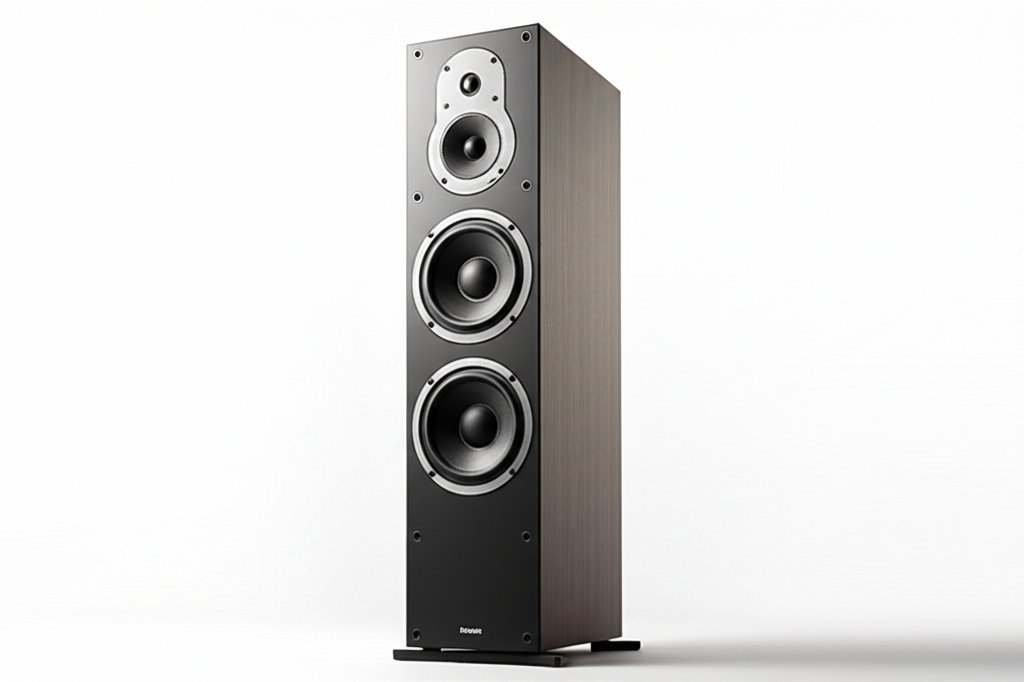
Complete floor standing speakers buying guide. Learn what features matter, compare top products, and find the best floor standing speakers for your budget.
View Top Picks →Table of Contents
Floor-Standing Speakers: The Home Audio Investment That Actually Lasts
Floor-standing (tower) speakers represent home audio's serious investment tier—products purchased once and kept for decades rather than replaced with each technology cycle. Unlike rapidly obsoleting electronics, quality speakers maintain relevance as long as their drivers and cabinets remain intact.
This longevity consideration should shape purchasing decisions. The $300 speaker that frustrates you for 15 years costs more in dissatisfaction than the $600 speaker that provides 15 years of satisfaction.
The Klipsch Sound Signature
Klipsch dominates Amazon's floor-standing bestsellers through a distinctive approach: horn-loaded tweeters and high sensitivity producing dynamic, forward sound that demands attention.
The Klipsch Reference R-26FA at $649 and the RP-8000F II at $1200 exemplify this approach. These speakers sound exciting—punchy, detailed, and present. They don't attempt neutrality; they attempt engagement.
This sound signature divides opinions:
- Enthusiasts describe Klipsch as "exciting," "dynamic," and "alive"
- Critics describe the same sound as "bright," "forward," and "fatiguing"
Neither assessment is wrong—they describe the same objective reality with different value judgments. The Klipsch sound is exceptional for certain content (action movies, rock/pop music, home theater impact) and potentially tiresome for other content (extended classical listening, acoustic recordings, background music).
High sensitivity (94-98 dB) means Klipsch speakers produce significant volume from modest amplification. Budget receivers can drive Klipsch towers effectively, where less efficient speakers might require more powerful (expensive) amplification.
The Sony Alternative
Sony's SS-CS3 at $398/pair represents more traditional speaker voicing—flatter frequency response, less aggressive presentation, conventional driver technology.
These speakers prioritize accuracy over excitement. They sound "correct" rather than "thrilling"—faithful to recordings without adding sonic signatures. For listeners who want speakers that disappear, allowing recorded performances to speak for themselves, this approach appeals.
The trade-off: compared to Klipsch, Sony speakers can sound polite, lacking the visceral impact that makes home theater explosions and rock music concerts feel powerful.
Neither approach is superior—they serve different listener preferences and different use cases.
The Dayton Audio Value Play
Dayton Audio's Classic T65 at $230/pair occupies budget territory where compromises accumulate but value concentrates. These speakers won't match $600+ competitors in refinement, bass extension, or dynamic capability.
What they do provide: legitimate floor-standing speakers at the price of bookshelf-plus-stands alternatives. For budget-constrained buyers wanting tower speaker format without premium pricing, Dayton offers entry.
Expectation calibration matters. Budget towers provide better than soundbar or plastic computer speaker performance. They don't provide reference-quality listening. For modest systems in secondary rooms, basement home theaters, or first apartments, budget towers deliver appropriate value.
Room Considerations
Floor-standing speakers interact significantly with room acoustics—more so than bookshelf speakers due to deeper bass extension and larger driver movement.
Room placement affects:
- Bass response (corner placement reinforces bass, sometimes excessively)
- Imaging (distance from side walls affects soundstage width)
- Room modes (standing waves create bass peaks and nulls at specific frequencies)
Large speakers in small rooms can overwhelm—excessive bass, insufficient distance for drivers to integrate, and general overload. Floor-standing speakers suit rooms with at least 12x15 feet of listening space.
Subwoofer supplementation, common with bookshelf speakers, becomes less necessary with floor-standing speakers whose larger cabinets and drivers extend bass response. Full-range floor-standing speakers may not need subwoofers at all; adding them requires careful integration to avoid bass bloat.
Amplification Requirements
Speaker sensitivity (measured in dB) indicates how much volume speakers produce from given amplification power. Higher sensitivity speakers need less amplification; lower sensitivity speakers need more.
Klipsch's 94-98 dB sensitivity means modest receivers (50-75 watts) drive them effectively. Less sensitive speakers (84-87 dB) may require more substantial amplification to reach satisfying volumes.
This matters for system budgeting. A $600 pair of low-sensitivity speakers requiring a $500 amplifier to perform well costs more in total than a $800 pair of high-sensitivity speakers that performs well with a $200 receiver.
The Atmos-Ready Question
Some floor-standing speakers (like the Klipsch R-26FA) include upward-firing drivers for Dolby Atmos compatibility—bouncing height effects off ceilings rather than requiring separate ceiling speakers.
Effectiveness varies with ceiling height and material. Flat, standard-height ceilings around 8 feet work best. Vaulted ceilings, very high ceilings, or acoustically absorptive ceilings diminish upward-firing driver effectiveness.
For dedicated home theater use with Atmos content, height capability adds value. For primarily music listening, upward-firing drivers add cost without benefit.
Listening Before Buying
Speaker sound is subjective—preferences vary legitimately. The best purchasing approach involves listening to candidates playing music you know well.
If retailer audition isn't possible (increasingly common with online-dominated retail), extensive review reading from multiple sources helps, and return policies become essential. Amazon's return window enables home audition—listen in your actual room, with your actual electronics, playing your actual content before committing.
Longevity and Value
Quality speakers last 20-30 years with care—drivers rarely fail, cabinets don't obsolete, and crossovers use passive components with indefinite lifespan.
This longevity justifies higher initial investment. A $1000 speaker providing 20 years of enjoyment costs $50/year. A $400 speaker replaced every 5 years due to dissatisfaction costs $80/year while never providing satisfying performance.
Consider speaker purchases differently than electronics that obsolete rapidly. The investment horizon spans decades, not product cycles.
Practical Recommendations
For home theater enthusiasts: Klipsch's dynamic presentation suits movie impact. The horn-loaded design delivers the punch that makes action movies visceral.
For music-first listeners: Audition alternatives to Klipsch, which may sound too aggressive for extended music listening. Sony and similar flat-response speakers may suit better.
For budget constraints: Dayton Audio provides tower format at bookshelf pricing. Expectations should match investment—acceptable performance, not exceptional.
For serious investment: Consider speakers in the $1000-2000 range from established audiophile brands. The jump from budget to mid-tier provides significant quality improvement; the jump from mid-tier to premium provides diminishing but real returns.
For small rooms: Consider whether floor-standing speakers are appropriate. Quality bookshelf speakers may provide better performance in space-constrained environments.
Frequently Asked Questions
Mitä minun pitäisi ottaa huomioon ostaessani lattiakaiuttimia?
Keskeisiä tekijöitä ovat rakennuslaatu, käyttäjien arvostelut ja vastine rahalle. Parhaiten arvioidut vaihtoehdot, kuten Klipsch Klipsch Reference R-26FA lattiakaiutin (4,7★ 922 arvostelusta), osoittavat, miltä laatu näyttää tässä kategoriassa.
Kuinka paljon lattiakaiuttimet yleensä maksavat?
Hinnat vaihtelevat 160 dollarista 1600 dollariin, ja useimmat laadukkaat vaihtoehdot ovat noin 570 dollaria. Alle 240 dollarin budjettivaihtoehdot toimivat satunnaiseen käyttöön, kun taas yli 855 dollarin premium-mallit tarjoavat paremman kestävyyden ja ominaisuudet.
Mitkä lattiakaiuttimet ovat tällä hetkellä suosituimpia?
Klipsch Reference R-26FA -lattiakaiutin on tällä hetkellä huippuluokan 4,7★ 922 Verified Reviews -arvostelulla. Katso kaikki suosituimmat valinnat osoitteesta /best/floor-standing-speakers.


