 PickPundit
👶 How to Choose the Best Baby Gates: Complete Buying Guide

Complete baby gates buying guide. Learn what features matter, compare top products, and find the best baby gates for your budget.
View Top Picks →Table of Contents
Baby Gates: The Unsexy Purchase That Prevents Real Emergencies
Baby gates represent one of parenting's least exciting purchases—functional safety equipment that nobody displays proudly on Instagram. Yet the difference between a properly installed gate and a cheap one that pops loose could be your toddler tumbling down stairs. Understanding gate types, mounting methods, and width requirements prevents both wasted money and genuine safety failures.
Pressure-Mounted vs Hardware-Mounted
This distinction matters more than any other feature:
Pressure-mounted gates use spring-loaded tension to wedge between walls. Installation requires no tools or wall damage. They're convenient, removable, and completely inadequate for stair tops. The pressure that holds them in place can be overcome by a determined toddler pushing or swinging on the gate.
Hardware-mounted gates screw directly into wall studs or use included hardware for secure attachment. They require drilling holes but create genuinely immovable barriers. For stairs, this is the only acceptable option—the JPMA (Juvenile Products Manufacturers Association) explicitly recommends hardware mounting for stair tops.
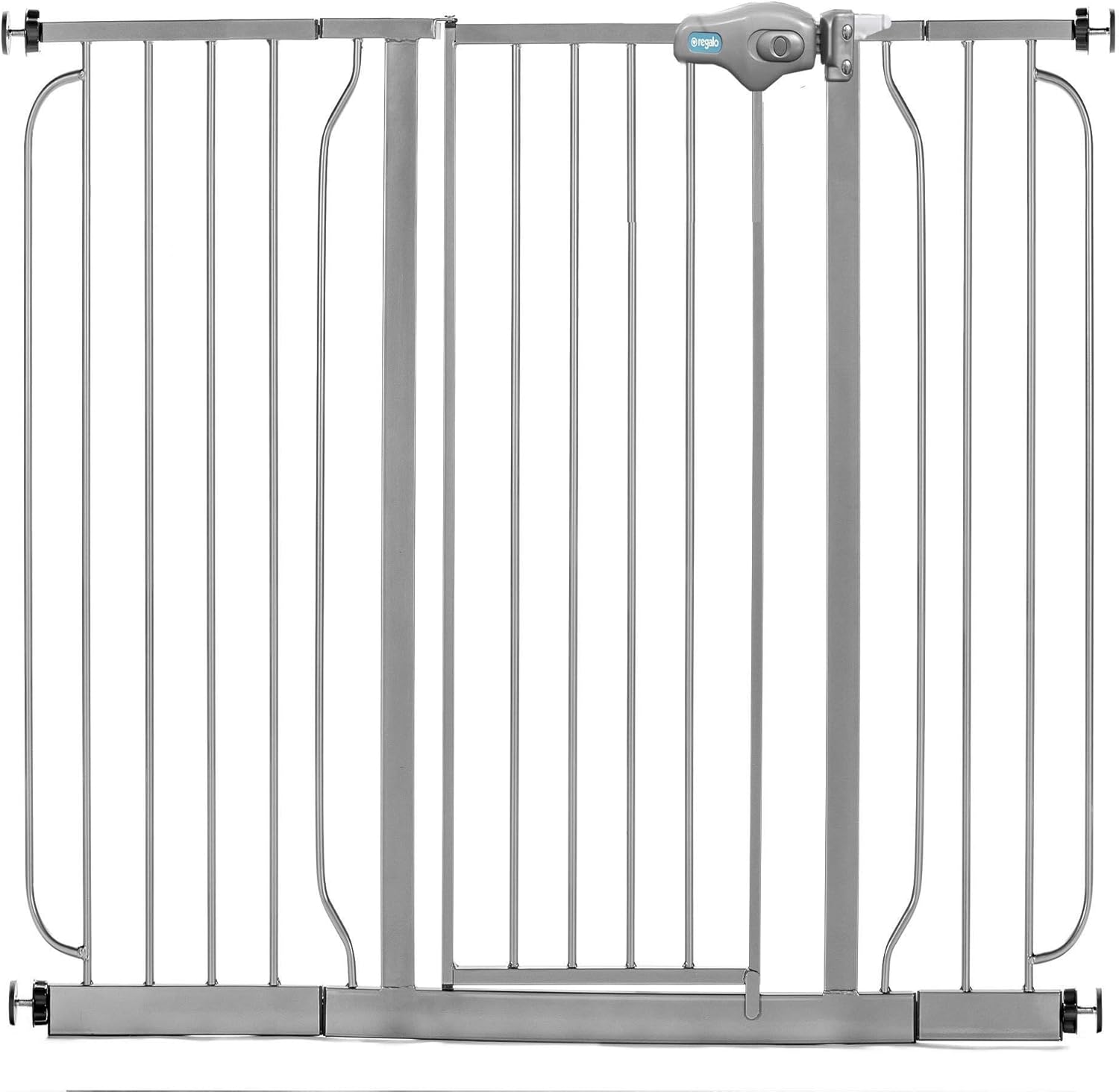
The Regalo Easy Step at $56 offers pressure mounting with optional hardware kit. The Cumbor at $90 comes hardware-ready with wall cups included. For stair protection, pay for hardware mounting or accept the limitation of pressure-mount-only placement.
Width Adjustability and Extensions
Baby gates quote adjustable width ranges, but understanding the numbers prevents returns:
Base width covers the gate's adjustment range without extensions—typically 29-40 inches. Most standard doorways fall within this range.
Extended width requires purchasing additional extension panels. Gates like the DEARBB at $140 advertise 77-inch widths, but reaching maximum width requires buying multiple extensions and creates increasingly wobbly installations.
Practical advice: Measure your openings precisely before purchasing. A gate stretched to its maximum adjustment range loses rigidity. Buy a gate whose comfortable middle-range covers your opening, not one maxed out at your measurement.
Height Considerations
Standard baby gates measure 28-32 inches tall—adequate for most toddlers until around age two. Taller gates (36+ inches) exist for:
- Determined climbers who scale standard heights
- Large dogs that jump over shorter barriers
- Unusual doorways with higher mounting needs
The 36-inch height on premium gates like the listed Baby Gate for Stairs ($73) provides extra margin against adventurous toddlers, but most families find standard heights sufficient for typical use.
Walk-Through vs Step-Over
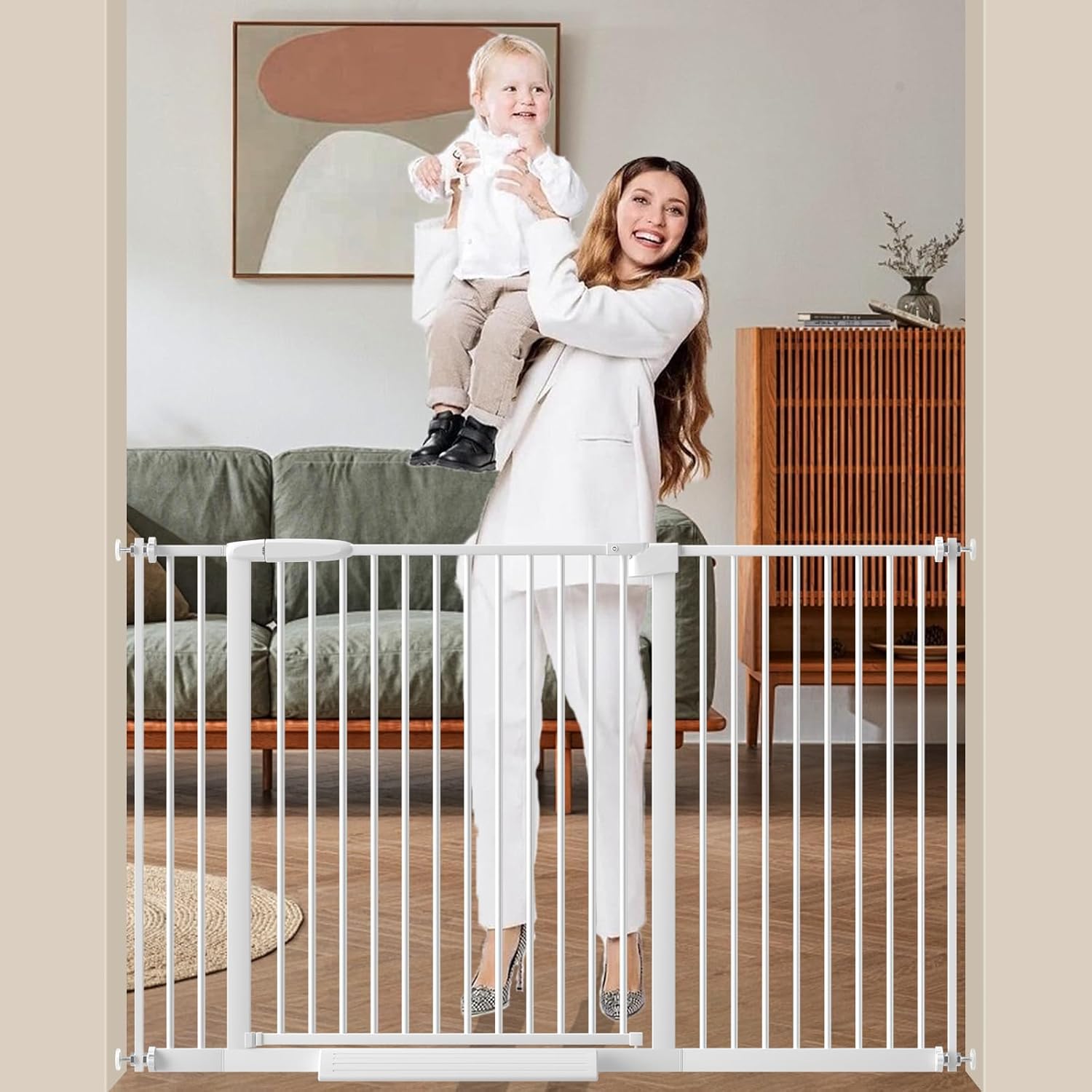
Walk-through gates include doors that swing open for adult passage. Step-over gates require lifting legs over the barrier—impractical while carrying children, laundry, or basically anything.
Walk-through gates cost more but dramatically improve daily livability. The convenience difference between opening a door one-handed and awkwardly stepping over a barrier while holding a baby justifies the price premium for high-traffic locations.
The Toddleroo by North States at $25 represents budget plastic construction, while walk-through metal gates start around $50-60. For locations you pass through dozens of times daily, spend for walk-through convenience.
One-Hand Operation
Marketing frequently touts "one-hand operation" without explaining what that means practically:
Squeeze-release latches require gripping and lifting simultaneously—technically one hand but requiring specific technique.
Slide latches involve pushing a button while lifting—easier one-handed operation when the mechanism is smooth.
Auto-close features swing the gate shut automatically after passing through—useful for busy parents who forget to close gates.
Test latching mechanisms if possible before purchasing. A gate that's theoretically one-handed but requires contortions to actually open defeats convenience purposes.
Metal vs Plastic Construction
Metal gates (steel, aluminum) provide superior durability and security. They resist pushing, pulling, and the general abuse toddlers inflict. Most hardware-mounted gates use metal construction.
Plastic gates cost less and weigh less but flex under pressure. Budget options like the Toddleroo work for low-stakes applications—blocking access to a home office, perhaps—but inadequately protect against falls.
For stair protection specifically, metal construction with hardware mounting represents the minimum acceptable safety standard. Budget plastic gates belong in non-critical doorway applications only.
Retractable Gates
Retractable mesh gates roll into side-mounted housings when not in use—solving the visual clutter problem of traditional gates. However:
- Mesh provides less physical resistance than rigid gates
- Retraction mechanisms can fail over time
- Installation typically requires hardware mounting anyway
- Price premiums run 2-3x compared to traditional gates
Retractable gates suit aesthetic-conscious applications in non-stair locations. They're not optimal for primary safety applications where maximum resistance matters.
Pet Considerations
Homes with both babies and pets face compound challenges:
Cat doors built into gates let cats pass while blocking toddlers—useful when cat food or litter boxes require access.
Dog-specific height/strength matters for large breeds. A gate rated for 25-pound toddlers may not withstand 60-pound dog impacts.
Walk-through width becomes more important when carrying pets, pet supplies, or managing multiple moving beings simultaneously.
Installation Reality
Hardware-mounted gates require:
- Locating wall studs (critical for secure mounting)
- Drilling holes (creating permanent wall damage)
- Proper hardware selection for wall types (drywall differs from plaster differs from masonry)
Pressure-mounted gates require:
- Level floors and parallel walls
- Walls that can withstand tension without damage
- Regular checking since pressure can loosen over time
Neither installation type is foolproof. Both require periodic inspection to ensure continued security.
Practical Recommendations
For stair tops: Hardware-mounted metal gates exclusively. No pressure-mount gates regardless of marketing claims. Budget $70-100 for quality stair protection.
For doorways: Pressure-mounted walk-through gates provide convenience without wall damage. Budget $50-70 for metal construction with easy latching.
For wide openings: Extra-wide gates exist but become increasingly unstable. Consider mounting multiple standard gates or exploring custom solutions for openings beyond 60 inches.
For temporary use: Pressure-mounted gates make sense when flexibility outweighs maximum security—grandparents' homes, rental properties, or travel situations.
The bottom line: baby gates are safety equipment, not decorative items. Prioritize secure mounting and solid construction over aesthetics or budget. A gate that fails costs infinitely more than buying the right gate initially.
Frequently Asked Questions
What should I look for when buying baby gates?
Key factors include build quality, user reviews, and value for money. Top-rated options like the Ozzy & Kazoo Baby Gate for Stairs (4.4★ from 35 reviews) demonstrate what quality looks like in this category.
How much do baby gates typically cost?
Prices range from $25 to $185, with most quality options around $83. Budget options under $37 work for occasional use, while premium models over $125 offer better durability and features.
Which baby gates are most popular right now?
The Baby Gate for Stairs is currently top-rated with 4.4★ from 35 verified reviews. Check our full comparison at /best/baby-gates for all top picks.
⚖️ Quick Comparison
| Product | Price | Rating | Key Feature |
|---|---|---|---|
|
#1
|
$72.66 | ADJUSTABLE FOR WIDE OPENINGS - Safely block areas from 28.5” to 40” wide with th... | |
| $56.31 | XTRA WIDE Expands to fit openings between 29-38 and 42-49 inches wide. Stands 30... | ||
| $139.99 | Ultra Narrow Spacing - The gate features a 1.37" spacing to prevent pets or chil... |