 PickPundit
📦 How to Choose the Best Keyboard Amplifiers: Complete Buying Guide

Complete keyboard amplifiers buying guide. Learn what features matter, compare top products, and find the best keyboard amplifiers for your budget.
View Top Picks →Table of Contents
Keyboard Amplifiers: Why Electronic Instruments Need Different Amplification
Keyboard amplifiers and electronic drum monitors serve fundamentally different purposes than guitar amps. While guitar amplifiers color and shape sound as part of the instrument's voice, keyboard amps must accurately reproduce full-frequency-range signals without coloration—the keyboard's sound is complete; the amplifier's job is faithful reproduction.
Understanding this distinction prevents purchasing guitar amps for keyboards (a common mistake) and guides selection toward appropriate monitoring solutions.
The Full-Range Requirement
Keyboards, synthesizers, and electronic drums produce sounds across the full audible frequency spectrum—from deep bass to high treble. Guitar amps, designed for guitars' limited frequency range, typically roll off frequencies outside that range and add characteristic coloration.
Keyboard amplifiers use:
- Full-range speaker systems covering 40Hz-20kHz (or wider)
- Flat frequency response without intentional coloration
- Multiple drivers (woofers for bass, tweeters for highs) rather than single guitar-style speakers
- Power sections designed for clean, uncolored amplification
The Coolmusic DM series exemplifies purpose-built electronic instrument amplification—designed for keyboards, electronic drums, and similar full-range sources.
Electronic Drum Amplifier Needs
Electronic drums present specific amplification challenges:
Dynamic range: Drums produce extreme dynamics—whisper-quiet ghost notes to thunderous hits. Amplifiers must handle these extremes without distortion or compression.
Low frequency reproduction: Kick drums produce powerful low frequencies that stress speakers. Insufficient bass capability produces thin, unsatisfying drum sound.
Attack clarity: Drum transients (the initial attack of each hit) define the instrument. Amplifiers must reproduce these accurately without smearing.
The Coolmusic DM80 at $160 and DM100 at $190 target these requirements specifically, with wattage appropriate for personal practice through small venue performance.
Wattage and Volume
Keyboard amplifier wattage requirements differ from guitar amp expectations. Guitar amps achieve "loud enough" at 15-30 watts for practice and 50-100 watts for gigging. Keyboard amps need more power:
Practice use: 20-40 watts sufficient for personal monitoring
Rehearsal with band: 60-100 watts to compete with acoustic drums and guitar amps
Performance: 100-200+ watts for stage volume
The Coolmusic DM20 at $90 suits personal practice; the DM80/DM100 suits rehearsal and small performance contexts.
Monitor vs PA System
For keyboard and electronic drum amplification, users face a choice: dedicated keyboard amp or connection to PA system.
Keyboard amp advantages:
- Self-contained, portable monitoring solution
- No dependency on venue or shared equipment
- Immediate setup without sound system complexity
- Personal control over monitoring
PA system advantages:
- Potentially higher quality at venue systems
- Front-of-house sound reaching audience, not just performer
- Less equipment to transport (if PA provided)
- Scalable to any venue size
For practice and rehearsal, keyboard amps are ideal. For performance, many keyboardists use keyboard amps as stage monitors while also sending signal to venue PA systems.
Bluetooth Connectivity
Modern keyboard amps increasingly include Bluetooth audio input—useful for:
- Playing backing tracks from phones/tablets
- Practicing with recorded music
- Flexibility in audio source connection
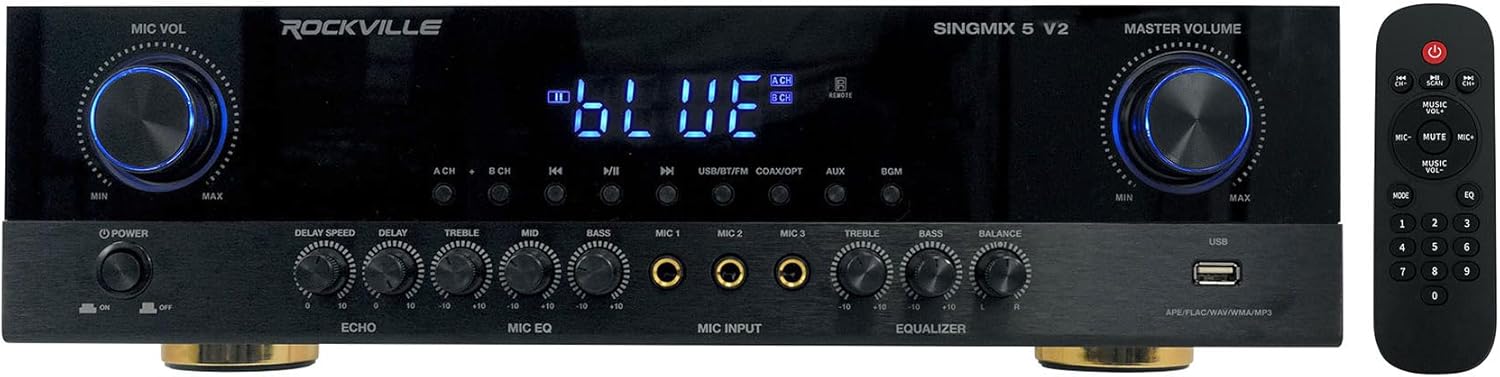
The Rockville SINGMIX 5 at $210 emphasizes this connectivity for home/karaoke contexts where varied audio sources matter.
Bluetooth adds latency (delay) that makes it unsuitable for real-time instrument monitoring but acceptable for backing track playback and recorded music.
Build Quality and Portability
Keyboard amps transport regularly—to rehearsals, gigs, and between rooms. Build quality affects longevity:
Durable construction: Reinforced corners, substantial handles, protected controls
Reasonable weight: Gigging musicians carry equipment repeatedly
Practical dimensions: Must fit in vehicles and through doorways
Premium amps in this category balance power with portability. The largest, most powerful amps may exceed practical transport for solo musicians.
Multiple Input Channels
Keyboard amplifiers often include multiple input channels—useful for:
- Multiple keyboards/sound modules
- Microphone input for singing keyboardists
- Backing track input alongside live instrument
- Drum module plus backing tracks simultaneously
The Rockville's multiple channels and mixing capabilities suit multi-source setups; simpler Coolmusic models suit single-instrument monitoring.
Positioning and Sound Quality
Unlike guitar amps (often positioned on floor, aimed at audiences), keyboard amps benefit from:
Elevated positioning: Brings speakers to ear level for accurate monitoring
Tilting capability: Some amps include tilt-back stands for floor placement with upward angle
Distance from walls: Prevents bass buildup and unclear sound
Many keyboard amps include pole-mounting sockets, enabling speaker-stand mounting that optimizes positioning. This flexibility suits varied venue setups.
The Personal Monitor Alternative
For some applications, personal in-ear monitors or powered monitors (like studio monitors) provide alternatives to traditional keyboard amps:
In-ear monitors: Maximum isolation and portability, but separation from natural room sound
Studio monitors: Excellent accuracy, but typically require nearby power and aren't road-rugged
Keyboard amps: Purpose-built balance of accuracy, power, and durability
For stage performance, keyboard amps' combination of volume, durability, and purpose-built design typically outperforms alternatives.
Practical Recommendations
For home practice: The Coolmusic DM20 at $90 provides adequate personal monitoring without overkill.
For rehearsal with bands: The DM80 at $160 or DM100 at $190 provides volume competing with acoustic drums and guitar amps.
For performance and versatility: Units with multiple channels, higher wattage, and pole-mount capability suit varied contexts.
For multi-purpose (music plus karaoke/presentations): The Rockville-style PA hybrids offer flexibility beyond pure instrument monitoring.
For electronic drums specifically: Prioritize low-frequency capability and dynamic range handling—the DM series explicitly targets drum amplification needs.
Frequently Asked Questions
What should I look for when buying keyboard amplifiers?
Key factors include build quality, user reviews, and value for money. Top-rated options like the COOLMUSIC Coolmusic Electric Drum AMP 80-Watt Electronic Dru (4.6★ from 183 reviews) demonstrate what quality looks like in this category.
How much do keyboard amplifiers typically cost?
Prices range from $90 to $935, with most quality options around $298. Budget options under $135 work for occasional use, while premium models over $447 offer better durability and features.
Which keyboard amplifiers are most popular right now?
The Coolmusic Electric Drum AMP 80-Watt Electronic Drum Amplifie is currently top-rated with 4.6★ from 183 verified reviews. Check our full comparison at /best/keyboard-amplifiers for all top picks.