 PickPundit
📦 Hoe u de beste DSLR-camera's kiest: complete koopgids

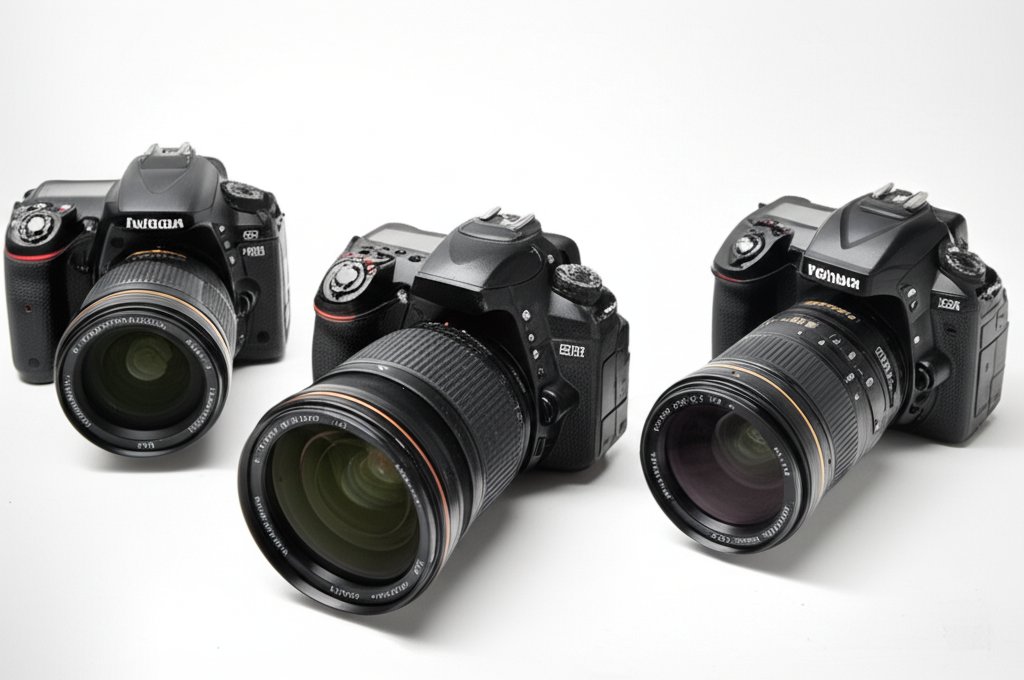
Complete dslr cameras buying guide. Learn what features matter, compare top products, and find the best dslr cameras for your budget.
View Top Picks →Table of Contents
DSLR Cameras: The Established Standard for Interchangeable-Lens Photography
DSLR (Digital Single-Lens Reflex) cameras use mirror systems and optical viewfinders—technology that dominated professional and enthusiast photography for decades. Understanding DSLR versus mirrorless trade-offs helps decide which system suits your photography journey.
How DSLRs Work
The reflex mirror system:
Mirror and pentaprism: Mirror reflects lens view to optical viewfinder.
When you shoot: Mirror flips up, exposing sensor.
Optical viewfinder: Direct through-lens view with no lag or battery drain.
Distinct sound: The satisfying mechanical mirror slap.
The Canon EOS Rebel T7 represents entry-level DSLR—accessible interchangeable-lens photography.
DSLR vs Mirrorless
Current camera market reality:
DSLRs: Proven technology, extensive lens selection, often better battery life.
Mirrorless: Electronic viewfinder, smaller bodies, newer technology investment.
Industry direction: Manufacturers focusing on mirrorless development.
DSLR value: Excellent used market, mature lens ecosystem, proven reliability.
Entry-Level DSLR Value
Why beginners still consider DSLRs:
Price point: Entry DSLRs often cheaper than comparable mirrorless.
Bundle deals: Kit lens, bag, memory card packages common. Canon Rebel bundles popular.
Learning tool: Manual controls teach photography fundamentals.
Lens investment: Mount system determines future lens options.
Canon vs Nikon Entry Level
Traditional DSLR rivalry:
Canon Rebel series: T7, T8i—beginner-friendly interface.
Nikon D3xxx/D5xxx series: Comparable features, different ergonomics.
Both excellent: Neither objectively better for beginners.
Choice factors: Brand preference, specific lens needs, ergonomic feel.
Understanding Sensor Sizes
APS-C vs full-frame:
APS-C (crop sensor): Entry and enthusiast DSLRs. Smaller, lighter, cheaper.
Full-frame: Professional cameras. Larger sensor, better low-light, shallower depth of field.
Crop factor: APS-C multiplies lens focal length appearance (1.5x-1.6x).
Starter recommendation: APS-C provides excellent learning platform.
Kit Lens Reality
What comes with bundles:
18-55mm kit lens: Standard starter lens. Adequate for learning.
Limitations: Slow aperture (f/3.5-5.6), soft at extremes.
Upgrade path: First lens upgrade dramatically improves results.
Don't dismiss: Kit lens teaches fundamentals before investing in primes or zooms.
Lens Investment
The system advantage:
Interchangeable lenses: Buy camera once, build lens collection over years.
Mount compatibility: Canon EF, Nikon F—lenses work across body generations.
Lens quality matters: Great lens on entry body often beats kit lens on pro body.
Buy once, buy right: Quality lenses retain value and last decades.
Autofocus Systems
How DSLRs focus:
Phase detection AF: Fast, accurate for still subjects and action.
AF points: More points = more flexibility. Entry cameras have fewer points.
Live view AF: Contrast detection—slower than viewfinder AF on DSLRs.
This is where mirrorless excels: Newer mirrorless has superior live view/video AF.
Video Capabilities
DSLRs for video:
1080p standard: Full HD video on entry cameras.
4K: Limited on entry DSLRs. Mirrorless often better for video.
Autofocus in video: DSLR weakness—contrast AF slow for video.
Audio: External microphone input important for serious video.
Learning Photography
DSLRs as teaching tools:
Manual modes: Learn exposure triangle (aperture, shutter, ISO).
Immediate feedback: Review shots, adjust, reshoot.
Physical controls: Dedicated dials and buttons for settings.
Investment commitment: Having dedicated camera encourages learning.
Bundle Contents
What Canon bundles typically include:
Camera body: The core investment.
Kit lens (18-55mm): Basic zoom for learning.
Memory card: Storage for photos.
Bag: Camera protection.
Accessories: Strap, cleaning kit, extra battery vary by bundle.
Practical Recommendations
For photography beginners: Canon Rebel T7 or Nikon D3500 bundle. Learn fundamentals affordably.
For serious hobbyists: Consider mid-range DSLR or entry mirrorless for better features.
For video focus: Mirrorless likely better choice for video-centric work.
For budget conscious: Used DSLRs offer excellent value. Previous generation bodies perform well.
The key insight: DSLRs remain capable cameras despite industry mirrorless shift. Entry DSLRs teach photography fundamentals effectively. Consider whether DSLR or mirrorless ecosystem aligns with long-term plans before investing in lenses.
Frequently Asked Questions
Waar moet ik op letten bij het kopen van DSLR-camera's?
Belangrijke factoren zijn onder meer bouwkwaliteit, gebruikersrecensies en waar voor uw geld. Top-rated opties zoals de Canon Canon EOS Rebel T7 DSLR camerabundel met Canon E (4.4★ uit 163 beoordelingen) laten zien hoe kwaliteit eruitziet in deze categorie.
Hoeveel kosten DSLR-camera's doorgaans?
Prijzen variëren van $ 389 tot $ 1999, met de meeste kwaliteitsopties rond $ 609. Budgetopties onder de $ 584 werken voor incidenteel gebruik, terwijl premiummodellen van meer dan $ 914 betere duurzaamheid en functies bieden.
Welke DSLR-camera's zijn momenteel het populairst?
De Canon EOS Rebel T7 DSLR-camerabundel met Canon EF-S 18-55M is momenteel best beoordeeld met 4,4 van 163 geverifieerde beoordelingen. Bekijk onze volledige vergelijking op /best/dslr-camera's voor alle topkeuzes.
⚖️ Quick Comparison
| Product | Price | Rating | Key Feature |
|---|---|---|---|
| $539.00 | This Camera Bundle Kit comes complete with all manufacturer supplied accessories... | ||
| $699.00 | Canon USA AUTHORIZED Includes Full USA Canon Warranty | 24.1MP APS-C CMOS Sensor... | ||
| $495.00 | Deluxe Bundle with Camera, 18-55mm Lens, Wide-angle and Telephoto, 128gb, Case, ... |


