 PickPundit
📦 Hvordan velge de beste bassforsterkerne: Komplett kjøpsguide

Complete bass amplifiers buying guide. Learn what features matter, compare top products, and find the best bass amplifiers for your budget.
View Top Picks →Table of Contents
Bass Amplifiers: The 58-Year Veteran Who Stuffed a Pillow Inside His $99 Fender
"I pulled the grill off and noticed a very cheap speaker... cabinet was hollow, no damping material. So the insides of an old fiber-filled pillow was sacrificed and cabinet stuffed, plus I cut foam to fill the port. Now we have an amp."
That 58-year bass player's Fender Rumble 25 modification reveals what budget practice amps actually are: decent electronics with cheap speakers and hollow cabinets. His $55 Celestion NEO speaker upgrade plus pillow-fiber damping transformed it: "Real nice lows and great tone... sorry I'm a purist and can't leave well enough alone."
The Fender Rumble Line Comparison Nobody Publishes
One extensive reviewer played in 3 bands, tested Rumble models, and provides the comparison Fender won't:
Rumble 25 vs 40 vs 100: "Personally I suggest the 100. Tried 40 but not powerful enough. The 100 only a little heavier than 40 (both around 25 pounds). Advantages of 100: more loud range, fatter low end with 10-inch speaker, about same portability... my Rumble 40 died TWICE at rehearsals so returned it."
The reliability detail matters—cranking a 40-watt amp to maximum for loud band rehearsals kills it. The 100-watt ($100 more) runs the same volume at 60% capacity, extending lifespan.
Weight reality: Rumble 25/40/100 all in 20-30 pound range—remarkably light for integrated combos. "Easy to carry in one hand with bass in other hand." The Rumble 15 serves quiet home practice. The 200 enters separate amp + speaker setup territory where integrated combos lose advantage.
The size-to-loudness sweet spot: "Think the 100 is the way to go... good tradeoff of sound, lightweight, fairly compact, decent price... 40 won't cut it for loud rehearsals."
Fender's product line intentionally segments: 15W (home only), 25W (home plus coffeehouse), 40W (pushing limits for band use), 100W (reliable band rehearsal), 200W+ (small venue gigging).
The $30-$50 Budget Practice Reality: GLARRY and JOYO
GLARRY at $28.34 (336 reviews, Amazon's Choice): "Can get really quiet or really loud. Good performance for how small it is." The 20W rating limits volume ceiling but handles bedroom practice fine. Includes MP3 input for play-along, headphone jack for silent practice.
JOYO MA-10B at $49.99 (2,428 reviews, 400 monthly purchases) earned extraordinary longevity testimonial: "2 years, everything still works 100%... battery life awesome, literally get 3-4 months regular playing from one set of 6AA batteries!"
That battery life on AA batteries (no wall power needed) plus 2-year durability transforms use cases: "played small acoustic gigs... practice with headphones... jam with smartphone... incredibly lightweight using guitar strap."
The realism: "Turn up too loud, speaker will distort—expected. Just loud enough to play nicely with acoustic guitar and singer. Speaker still sounds great after 2 years. Not going to rival my 25W Fender Rumble, but sounds good to me!"
The $50 JOYO working flawlessly for 2 years on AA batteries while the $140 Fender Rumble 40 died twice at rehearsals raises uncomfortable questions about reliability versus brand premium.
The Orange Analog Signal Path: "Super Clear and Old School Sound"
Orange Crush Bass 25 at $238.86 (407 reviews, 4.7 stars): "Keeping signal path all analogue delivers classic warm sound that makes Orange the choice of iconic bass players—Geddy Lee, John McVie, Glenn Hughes."
Orange Crush 50 at $399 (312 reviews, 4.8 stars): One beginner notes built-in LED tuner usefulness for verifying fretboard notes. "Volume all the way up, play deep notes without degrading or distorting quality." The analogue approach trades digital effects for tone purity.
The Orange premium ($238-$399 vs Fender $140-240) buys analog signal path integrity and that distinctive warm Orange sound. For players prioritizing tone character over digital versatility, this justifies the cost.
The BOSS Katana-110 Bass App Ecosystem
BOSS at $449.99 (55 reviews, 4.8 stars) integrates with Katana app for extensive tone customization. "Since Boss is leader in effects market, having variety of sounds at fingertips makes practice fun... definitely will shake the room."
One comparison: "Returned an Ampeg couple years ago because controls felt chintzy. Really like the build quality" of BOSS.
The $450 premium buys BOSS effects library accessibility via app, solid build quality exceeding competitors, and 110W class AB power with custom 10-inch woofer plus tweeter. For serious bassists wanting professional features in combo format, this represents the practice-to-performance crossover.
The Car Audio Amplifier Confusion
Soundstream Picasso Nano (car stereo amplifier) and Rockville/Taramps car bass amps appear in bass amplifier results. One motorcycle audio installer details: "Bought for Honda Valkyrie Interstate... wanted something heard over flat six engine with 6-into-6 straight pipes at 85-90mph."
The oscilloscope gain-setting review (measuring 32V before clipping) reveals car audio enthusiast methodology foreign to bass guitarists. These are subwoofer amplifiers for vehicles, not instrument amplifiers.
Category contamination: If you're buying bass GUITAR amplifier, skip the car audio products entirely. The ohm ratings (0.5-2 ohms) and wattage specs (3000-5000W) signal automotive application.
The Headphone Practice Amplifier Niche
Valeton Rushead Max at $39.99 (4,593 reviews—highest count excluding Fender models): USB rechargeable pocket amp plugs directly into bass. Amp models, cab sim, chorus/tremolo/flanger effects, reverb/echo, aux input for jamming. Up to 5 hours play time.
YGiTK headphone amplifier at $26.09 (headphone amp, not bass guitar amp): "Looking for compact headphone amp that performs well... can't pump volume with Bluetooth? This delivers... bass boost adjustment... no distortion."
For apartment dwellers needing silent practice or travelers wanting bass access without dragging 25-pound amps, the $40 pocket amp category solves real problems.
What the Pillow-Stuffer Knows That You Don't
That 58-year veteran's modifications reveal budget amp construction:
- Cheap speakers (even in $140 Fender models)
- Hollow cabinets without damping material
- Untuned ports
- First-rate workmanship on electronics, corners cut on acoustics
His solution: $55 Celestion NEO speaker + pillow-fiber damping + foam port fill = $155 total for amp that rivals $240 models. "I gave it 5 stars for $99, but now it's 6 stars."
Implication: Budget practice amps use quality electronics with budget acoustics. Speaker upgrade transforms sound. Advanced players know this; beginners don't.
The Wattage vs Speaker Size Matrix
10W (JOYO, Ueteto): Bedroom practice, headphone use. Battery-powered portability.
15-25W (Fender Rumble 15/25, Orange 25): Home practice, very small venues, won't survive loud band rehearsals.
40W (Fender Rumble 40): Borderline for band use—one reviewer's units died twice at rehearsal.
100W (Fender Rumble 100): Reliable band rehearsal, small venue gigging. Sweet spot for serious practice without separate amp/cab.
200W+: Small-to-medium venue performance. Consider separate amp/cab at this power level.
Speaker size matters as much as wattage: 10-inch speaker (100W Rumble) delivers "booming low range" versus 8-inch (40W Rumble). The physical cone size moves more air.
The Honest Framework
Bedroom practice only ($30-50): GLARRY, JOYO MA-10B with batteries, budget 20W amps. Accept speaker limitations.
Home + occasional small venue ($95-140): Fender Rumble 15/25. Fender reliability, headphone practice, MP3 play-along.
Serious practice + band rehearsals ($240-400): Fender Rumble 100 (reliability proven), Orange Crush 50 (analog warmth), BOSS Katana-110 (app effects). Don't underbuy power for loud rehearsal needs.
Travel/silent practice: Valeton Rushead pocket amp ($40), headphone-focused solutions.
Modification project: Budget Fender + $50-100 speaker upgrade. For gear enthusiasts who enjoy the modification process.
That review comparing Rumble 40 vs 100 ends with crucial advice: "Had hard time finding real-world feedback... if you want good tradeoff of sound, lightweight, compact, decent price, the 100 is the way to go. A 40 won't cut it for loud rehearsals."
The 58-year veteran's pillow-stuffing project and the 3-band player's Rumble 40 reliability failures both point to the same conclusion: don't buy at the absolute minimum of your needs. The next model up usually solves the limitations that cause returns and disappointment.
Frequently Asked Questions
Hva bør jeg se etter når jeg kjøper bassforsterkere?
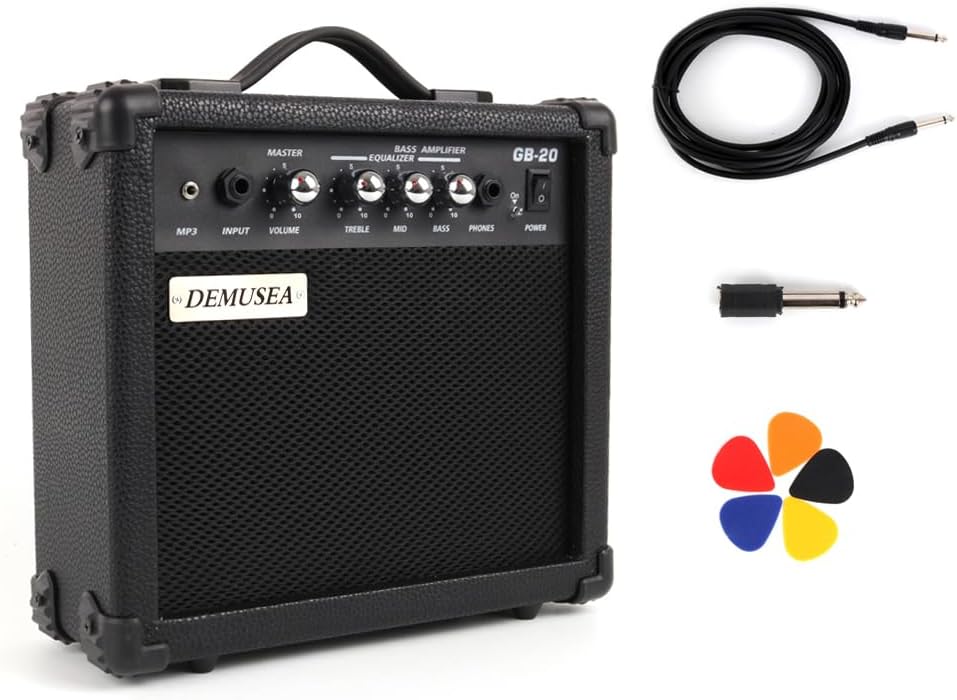
Nøkkelfaktorer inkluderer byggekvalitet, brukeranmeldelser og verdi for pengene. Topprangerte alternativer som DeMusea 20W watt elektrisk bassgitar svart forsterkerport (3,8★ fra 71 anmeldelser) viser hvordan kvalitet ser ut i denne kategorien.
Hvor mye koster bassforsterkere vanligvis?
Prisene varierer fra $26 til $499, med de fleste kvalitetsalternativer rundt $154. Budsjettalternativer under $39 fungerer for sporadisk bruk, mens premiummodeller over $231 tilbyr bedre holdbarhet og funksjoner.
Hvilke bassforsterkere er mest populære akkurat nå?
Den bærbare 20W watts elektriske bassgitaren Black Amplifier Portable Trave er for øyeblikket topprangert med 3,8★ fra 71 verifiserte anmeldelser. Sjekk vår fullstendige sammenligning på /best/bass-forsterkere for alle toppvalg.
⚖️ Quick Comparison
| Product | Price | Rating | Key Feature |
|---|---|---|---|
| $49.99 | See details | ||
|
#2
|
Check Price | See details | |
| $28.34 | See details |