 PickPundit
📦 Hvordan velge de beste bokhyllehøyttalerne: Komplett kjøpsguide

Complete bookshelf speakers buying guide. Learn what features matter, compare top products, and find the best bookshelf speakers for your budget.
View Top Picks →Table of Contents
Bookshelf Speakers: The Powered vs Passive Decision Most Buyers Skip
The bookshelf speaker category splits fundamentally between powered (active) speakers with built-in amplification and passive speakers requiring separate amplifiers. This distinction matters more than driver size, frequency response specifications, or any other technical detail—it determines your entire system architecture.
Most buyers default to powered speakers for simplicity, often not realizing they've made this architectural decision or its implications.
Powered Speakers: Convenience With Constraints
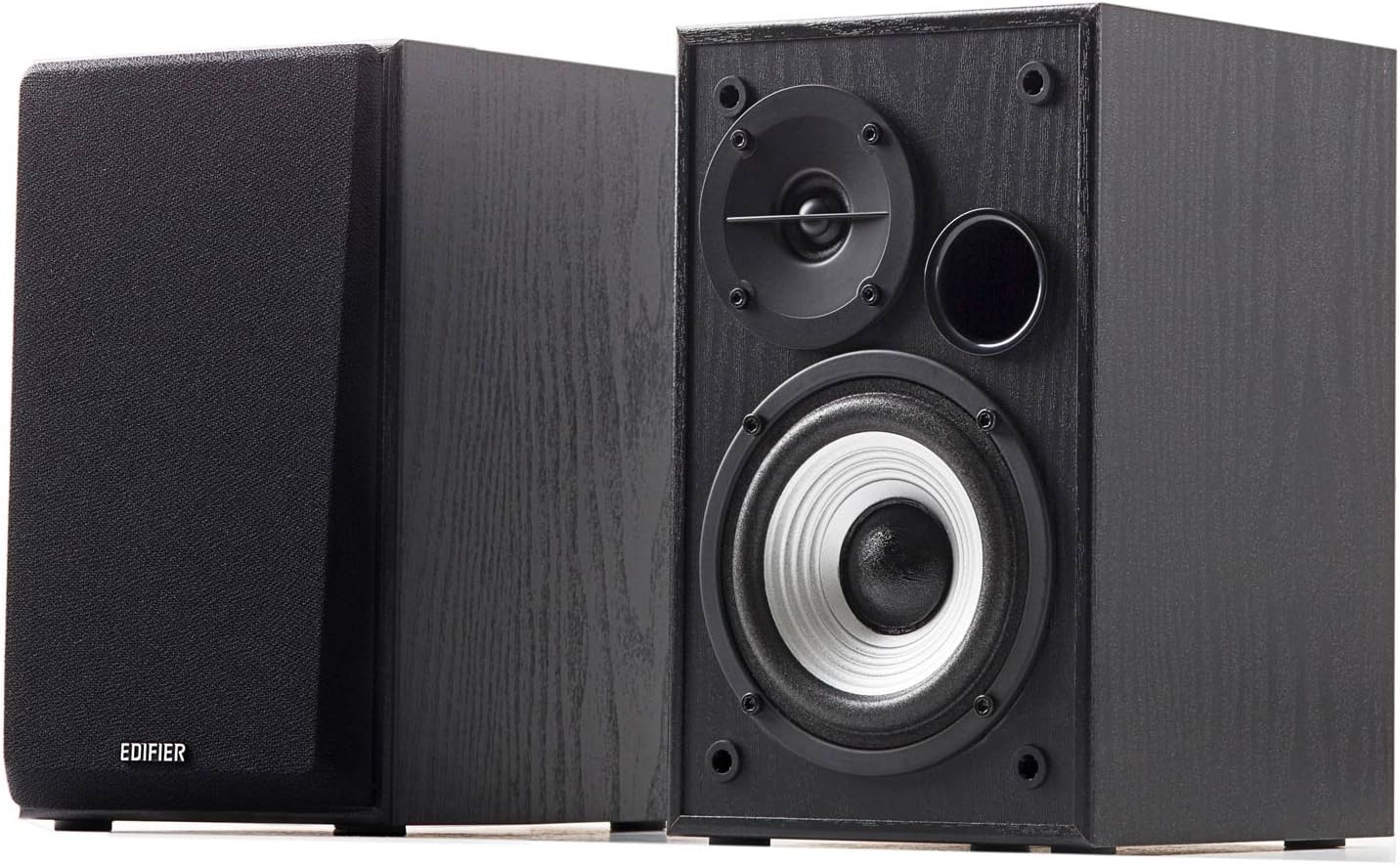
Powered bookshelf speakers contain amplifiers internally, requiring only audio input (Bluetooth, aux cable, optical) and power outlets. The Edifier R1280T at $120 exemplifies this approach: connect power, connect audio source, enjoy music. No separate amplifier purchase, no speaker wire runs, no matching amplifier power to speaker capacity.
The convenience has genuine value. These speakers work immediately with minimal setup, fitting apartments and desk setups where external amplifiers would add unwanted complexity. For near-field listening (positioned close to listening position, like computer speakers), powered bookshelf speakers provide excellent value.
The constraints emerge when considering upgrades or replacements. Internal amplifiers can't be upgraded independently—improving amplification means replacing entire speakers. If one channel's amplifier fails, you're potentially replacing both speakers rather than swapping a component. The integrated approach trades future flexibility for present simplicity.
Passive Speakers: The Audiophile Path
Passive speakers contain only drivers (woofers, tweeters) and crossover networks, requiring external amplification. This approach costs more initially—speakers plus amplifier—but enables independent upgrades and repairs.
Passive bookshelf speakers rarely dominate Amazon bestseller lists because they require buyer knowledge and additional purchases. The target audience understands component audio systems and specifically seeks passive designs. Budget-focused buyers gravitate toward powered speakers' lower entry cost and simpler setup.
For serious listening spaces, passive speakers paired with quality integrated amplifiers outperform powered alternatives at similar total investment. The external amplifier provides cleaner power with lower noise floors, and speakers can later be upgraded while retaining the amplifier (or vice versa).
The Edifier Phenomenon
Edifier dominates the powered bookshelf category through consistent quality at accessible prices. The R1280T at $120 and R980T at $100 represent the sweet spot—genuine wood enclosures, quality drivers, competent amplification, and Bluetooth/wired connectivity.
These speakers genuinely perform well for their price. They won't match audiophile passive setups at 3-4x the price, but they deliver satisfying sound for casual listening, desktop audio, and TV enhancement. Reviews criticizing "lack of bass" often reflect unrealistic expectations—4-inch drivers in bookshelf enclosures can't reproduce subwoofer frequencies. Adding a subwoofer addresses this limitation if deeper bass matters.
The R1280T adds Bluetooth over the R980T's wired-only input, justifying the $20 premium for most modern use cases. Bluetooth convenience for phone audio outweighs minor connectivity limitations.
The Saiyin Alternative
Saiyin speakers at $70-80 undercut Edifier pricing while approaching similar performance. The Saiyin 30W at $70 provides Bluetooth connectivity, adequate power for near-field listening, and reasonable sound quality for the price.
Build quality differences emerge on close inspection—Saiyin enclosures feel lighter, plastic components replace wood in some areas, and long-term durability remains less proven than established brands. For budget-conscious buyers willing to accept potential earlier replacement, Saiyin delivers value. For buyers wanting proven reliability, Edifier's track record justifies the premium.
Understanding Speaker Specifications (And Their Limitations)
Bookshelf speaker marketing emphasizes specifications: frequency response, wattage, driver size. These numbers provide some guidance but mislead without context.
Frequency response (e.g., "60Hz-20kHz") describes the range of sounds the speaker produces. Lower first numbers suggest deeper bass capability. However, specifications often omit how much the volume drops at frequency extremes. A speaker "reaching" 50Hz at -10dB produces barely audible bass at that frequency. Honest specifications include tolerance ranges (±3dB, for example).
Wattage in powered speakers describes amplifier power, not loudness. A 30W speaker isn't necessarily louder than a 20W speaker—speaker efficiency (how effectively the driver converts power to sound) varies. Two 30W speakers from different manufacturers may differ significantly in perceived volume.
Driver size (4-inch, 5-inch) correlates roughly with bass capability. Larger drivers move more air, enabling deeper bass reproduction. But enclosure design, driver quality, and crossover implementation affect results as much as raw size.
The takeaway: specifications enable rough comparison but can't replace listening experience. If possible, audition speakers before purchase. If buying online, prioritize reviewers describing actual listening impressions over those reciting specifications.
Room Acoustics and Placement
Bookshelf speakers interact with rooms in ways buyers often ignore. Placing speakers directly against walls reinforces bass through boundary effect—sometimes beneficially, sometimes creating boomy, undefined low end. Most speakers perform better with some distance (6-12 inches) from rear walls.
Desktop placement near computer monitors creates reflections from hard surfaces. Speaker stands positioning drivers at ear level improve sound significantly over desktop placement, but add cost and footprint that many buyers can't accommodate.
The honest assessment: most bookshelf speaker buyers place them on desks or shelves in non-ideal positions. Speakers designed for near-wall placement (front-ported rather than rear-ported designs) tolerate these compromises better. If purchasing for constrained placement, consider port location in the decision.
The Subwoofer Question
Bookshelf speakers by definition can't reproduce deep bass—their small enclosures limit low-frequency extension. Adding a subwoofer fills this gap but introduces complexity: placement optimization, crossover frequency matching, and level balancing.
For casual listening, many users don't miss deep bass. Music sounds engaging through bookshelf speakers alone, even without floor-shaking low end. For home theater applications or bass-heavy music genres, subwoofer addition becomes more compelling.
Many powered bookshelf speakers include subwoofer outputs, enabling future addition without replacing the speakers. This futureproofing has value even if you don't immediately add a subwoofer.
Practical Recommendations
For computer/desktop audio: The $70-120 range provides excellent value through Saiyin, Edifier R980T, or Edifier R1280T. These powered speakers deliver satisfying near-field sound without external equipment complexity.
For small room TV audio: Powered bookshelf speakers outperform many soundbars at similar prices, providing stereo separation that single-enclosure soundbars can't match. Positioning speakers on either side of the TV creates genuine stereo imaging.
For serious listening: Consider the passive speaker path with separate amplification. Entry-level options begin around $200-300 total (speakers plus amplifier), with upgrade paths available as budget and interest grow.
For budget buyers: The sub-$70 category provides acceptable sound for undemanding use, with Saiyin offering the best value. Set expectations accordingly—these won't compete with premium options but adequately serve basic needs.
Frequently Asked Questions
Hva bør jeg se etter når jeg kjøper bokhyllehøyttalere?
Nøkkelfaktorer inkluderer byggekvalitet, brukeranmeldelser og verdi for pengene. Topprangerte alternativer som Saiyin Saiyin Bluetooth-bokhyllehøyttalere (4,4★ fra 1 878 anmeldelser) viser hvordan kvalitet ser ut i denne kategorien.
Hvor mye koster bokhyllehøyttalere vanligvis?
Prisene varierer fra $50 til $329, med de fleste kvalitetsalternativer rundt $130. Budsjettalternativer under $75 fungerer for sporadisk bruk, mens premiummodeller over $195 tilbyr bedre holdbarhet og funksjoner.
Hvilke bokhyllehøyttalere er mest populære akkurat nå?
Saiyin Bluetooth-bokhyllehøyttalerne er for øyeblikket topprangert med 4,4★ fra 1878 bekreftede anmeldelser. Sjekk vår fullstendige sammenligning hos /best/bookshelf-talere for alle toppvalg.